The short answer
A recurring office lunch is priced per person, per service day. Our Office Meal Program starts from $21 a guest, and one-off office lunch packages from $21, all-in: the food plus the staff, delivery and setup the format needs. California sales tax is added on its own line and there is no service charge.
That figure is a floor, not a quote. Where a given office lands depends on three things more than the menu: the service format, the headcount and the number of days a week. The rest of this guide explains each, and compares a program honestly with the other ways an office can feed people.
Four ways to feed an office, compared
Before comparing prices it helps to compare models, because each one bills for different things, and a per-person number from one model is not the same quantity as a per-person number from another.
| Model | How it works | What the price covers | Where cost tends to hide |
|---|---|---|---|
| Recurring program | One caterer, agreed service days, a rotating menu, one invoice per period | Food, delivery, setup and any staff, priced per guest per service day | Format upgrades and extra service days; both are visible on the proposal |
| One-off catering orders | Each lunch is quoted, booked and invoiced on its own | The same things, per order | Staff time spent ordering, chasing and reconciling a separate invoice every time |
| Delivery apps | A marketplace: each order goes to a different restaurant | The food, with delivery and platform fees usually added at checkout | Fees, service charges and tips added after the menu price; labels and timing vary by vendor |
| In-house cafeteria | The company runs or contracts a kitchen on site | Space, equipment, staff, permits and food, whether or not people come in | Fixed costs that do not fall on low-attendance days |
A comparison of models, not of providers. Each one suits some offices.
A program against one-off catering
The food can be identical. Our one-off office lunch and the program draw from the same kitchen and the same menus, and both are quoted per guest, all-in. The difference is not the lunch, it is everything around it.
One-off ordering means someone in the office chooses a menu, collects dietary notes, places the order and reconciles an invoice every time. A program does that work once: the service days, dietary tracks, delivery window and invoice recipient are agreed up front, the menu calendar is planned weeks ahead, and the period is billed on one consolidated invoice itemized by service day. If lunch happens more than once or twice a month, the time saved is usually the larger part of the value.
A program against delivery apps
Delivery apps are good at one thing a program does not try to do: letting every employee pick from dozens of restaurants. If individual choice from a wide market is the point, an app is built for that.
What an app does not give an office is consistency. Each order goes to a different restaurant, so menus, allergen labeling and delivery timing change from vendor to vendor, and the price shown on the menu can differ from the price paid once delivery fees, service fees and tips are added. For a shared lunch that has to arrive at one time, feed every dietary requirement and reconcile cleanly, a program gives you one menu standard, one coordinator, one delivery window and one invoice. Every dish we serve is halal · zabiha-sourced and labeled, so the dietary question is answered once, not per order.
A program against an in-house cafeteria
A cafeteria can make sense for a large office with steady daily attendance. Its costs are mostly fixed: the space, the kitchen equipment, the staff, the permits and the management time are paid whether a hundred people eat or ten. When attendance is high and predictable, those costs spread thinly across many meals.
Hybrid work changes that arithmetic. On low-attendance days the fixed costs land on fewer meals, so the true cost of each one climbs. A program is the opposite shape: you pay per guest for the days you choose, so a quiet day costs less and the office carries no kitchen, equipment or staff of its own.
What moves the price
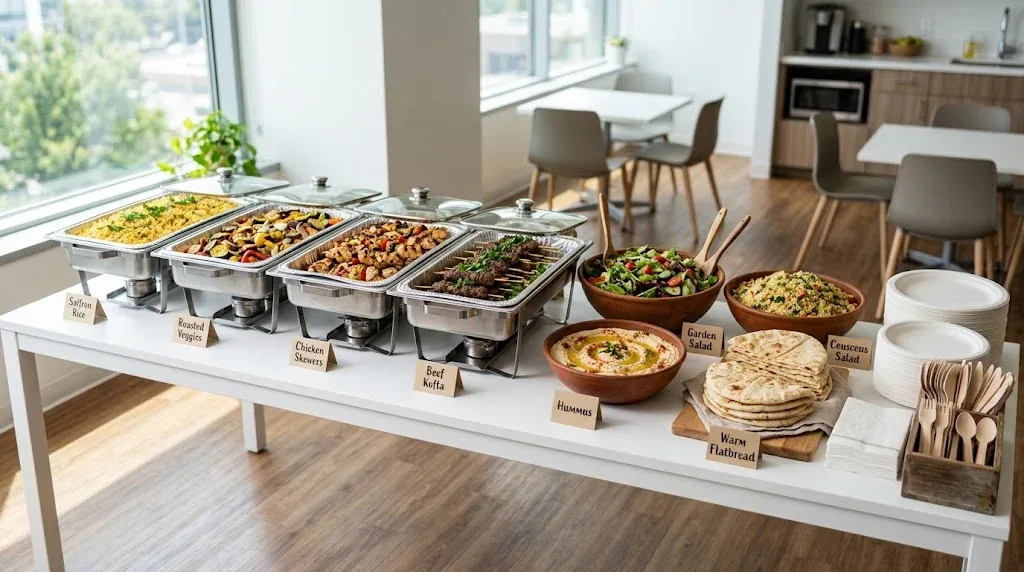
Service format is the largest single lever, because the difference between formats is mostly the crew rather than the food. Drop-off has no staff on site and sits lowest; a staffed buffet carries servers who set, run and clear the line. Boxed meals add the packing and labeling of one meal per person.
Headcount is the second. Delivery, setup and any crew are shared across the room, so the price per guest falls as the count rises. A program starts at 15 guests per service day; below that, the fixed costs dominate the per-person number.
Days per week set the total rather than the rate. Each service day is priced per guest, so three days costs about three times one day for the same headcount and format. Choosing days the office is actually full is the most reliable way to keep the monthly total in line with the value.
| Format | Per guest, all-in | What drives the number |
|---|---|---|
| Drop-off | $18–$38 | No staff on site; trays set out and labeled |
| Boxed meals | $18–$38 | One packed, labeled box per person |
| Staffed buffet | $46–$89 | Servers who set, replenish and clear the line |
Site-wide bands across every occasion, all-in per guest at each package minimum; office lunch packages start at $21 a guest. California sales tax is added and there is no service charge.
Turning it into a monthly budget
The calculation is simple once the three drivers are set: the per-guest rate for your format, times your typical headcount, times the number of service days in the period, plus sales tax at the delivery address. Because the rate is all-in, there is no separate setup or service-charge line to add. Delivery within 15 miles of our kitchen is included in the per-guest price; farther addresses are charged per extra mile, and a load that needs an extra vehicle is itemized, both on your proposal before you accept.
For scale, an office lunch starts from $21 a guest as a drop-off or boxed lunch, because those formats carry no crew in the room; a staffed buffet runs $46–$89 a guest. A written proposal prices your exact days, headcount and format line by line, which is the figure to put in a budget.
Questions to ask any provider
Whichever model you choose, these questions make two quotes comparable.
- Is the per-person price all-in, or are delivery, setup, staff, service charges or tips added later?
- Is sales tax included or shown separately?
- How is the invoice itemized, and can it be split by department or cost center?
- Can you put our PO number on the invoice, and do you offer net-30 terms to approved accounts?
- How is every dish labeled for allergens and dietary needs, and who checks the labels against our team's requirements?
- Who do we call if a delivery is late, and is it the same person every week?