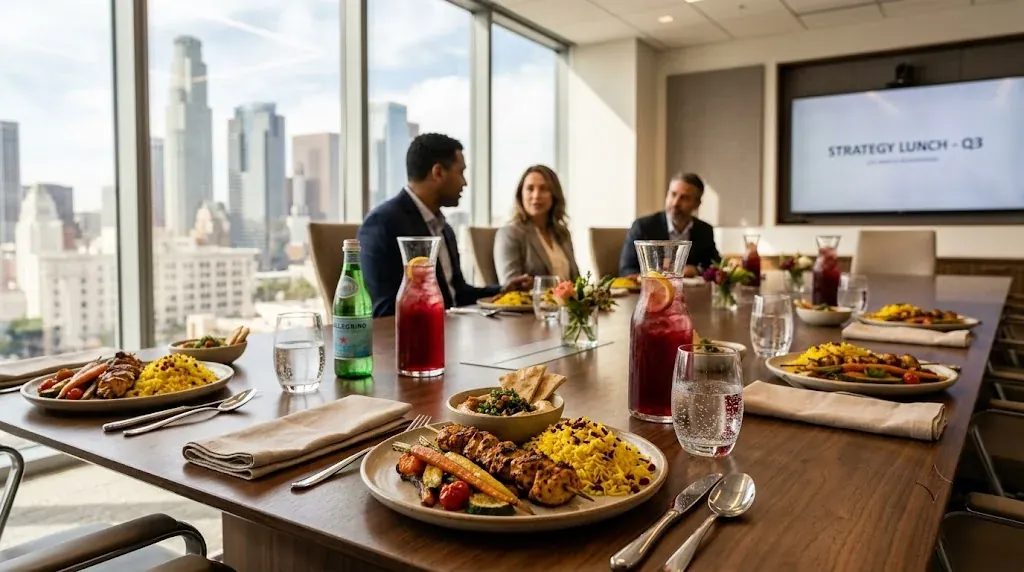
A program is a schedule, not a series of orders
Most offices start with one-off lunch orders: someone picks a restaurant, collects the dietary notes, places the order, chases the delivery and files the receipt. That works for a monthly all-hands. It stops working the week the office decides lunch should happen every Tuesday and Thursday, because the same person is now doing the same chores twice a week with nothing carried over from the last time.
An office lunch program replaces that loop with a standing arrangement. You agree the service days, the headcount, the dietary needs and the format once. The caterer then plans a menu calendar a few weeks ahead and shares it, delivers on the agreed days in the agreed window, and bills the whole period on one invoice. The office manager stops ordering lunch and starts reviewing it.
This guide walks through each decision in the order you will meet it, using how our Office Meal Program runs in Los Angeles and Orange County as the worked example.
Choosing your service days
Start with the days the office is fullest, not the days that feel right. In a hybrid office that usually means the two or three anchor days teams already plan around, and lunch on those days quietly reinforces them. A program can run one day a week, three, or every weekday, and adding or dropping a day later is a message rather than a new contract.
Two things are worth deciding up front. First, whether every service day feeds the whole office or just the teams that are in, since a program can run different menus or formats for different floors on the same day and deliver them per site. Second, how one-off events fit around it. An all-hands, a client lunch or an extra floor for a day is an adjustment to the standing order rather than a separate booking, and it lands on the same invoice.
How the menu rotation works
The thing that ends most office lunch arrangements is not quality, it is repetition. A team that sees the same three orders on a loop stops looking forward to lunch and starts eating at their desks. A program fixes that with a rotation rather than a repeat.
Ours runs on a six-week rotation drawn from the whole kitchen: Mediterranean mezze, taco and shawarma bars, BBQ trays, Indian and Persian mains, Korean, Thai and Italian. On a twice-weekly schedule that means a month and a half without seeing the same lunch. The calendar is planned a few weeks out and shared, so the room knows what is coming, and the rotation is weighted over time toward what your team actually finishes rather than what looked good on paper.
For a large or opinionated room, two or three cuisines can go on the same table on the same day. Above roughly forty people that is usually the right call, because it removes the argument and gives everyone something they chose.
Dietary tracks on one menu
A recurring lunch only works if nobody on the team is left with the side salad. The answer is not a separate order for each requirement, it is standing tracks that run every service day: vegetarian, vegan and gluten-free lines plated to match the main line, rather than arriving as an afterthought in a smaller container.
Every dish we serve is halal · zabiha-sourced by default, so a mixed office shares one menu and nobody is singled out at the line. We say zabiha-sourced because that is the claim we can stand behind about our suppliers; the kitchen does not hold a halal certification, and if your office needs a certificate on file, tell us early.
Each dish arrives labeled with its contents and allergens. Allergy flags you give us carry forward and are checked against each rotation before it is offered, so a new hire's requirement is a message, not something re-explained every week.
Boxed, buffet or drop-off
The format decides more about the day, and the price, than the menu does. The same program can switch format week to week: a staffed buffet on Monday and individually boxed desk lunches on Thursday is a normal configuration, not an exception.
| Format | What arrives | Suits | Our per-guest band |
|---|---|---|---|
| Boxed meals | One sealed, labeled box per person, sorted by team or floor | Hybrid days, desks, breakout rooms, staggered lunch hours | $18–$38 |
| Drop-off | Trays delivered, arranged and labeled with serving utensils; no staff stay | A team that can serve itself over a lunch hour | $18–$38 |
| Staffed buffet | A replenished line with on-site staff who set, run and clear it | A full floor, an all-hands, a room that mingles | $46–$89 |
Site-wide bands across every occasion, all-in per guest: food plus the staff, delivery and setup the format needs; office lunch packages start at $21 a guest. California sales tax is added and there is no service charge.
The delivery window
A program is judged on whether lunch is there when people need it, so the window is built backwards from when your team eats, not forwards from the kitchen, and held the same on every service day so nobody has to wonder.
In Los Angeles the window is shaped as much by the building as by the traffic. Tell us about the loading dock, the freight elevator, security sign-in and any rules about what can be brought onto a floor, and we plan the arrival around them. Hot food travels in insulated carriers so it arrives hot rather than held. Drop-off trays are set out and labeled before we leave; boxed meals arrive sorted by team or floor. If the program grows past one site, delivery windows are staggered across locations in one plan.
How invoicing works
This is the part that makes a program easier than one-off orders for the people who pay for it. Instead of a receipt per lunch, you receive one consolidated invoice for the period, itemized by service day with per-guest detail, so a workplace lead can reconcile it at a glance and finance can split the lines by department or cost center.
Pricing is per guest for each service day, all-in: the food plus the staff, delivery and setup the format needs. There is no service charge, and California sales tax is shown on its own line. If your company raises purchase orders, quote the PO number and it goes on the invoice as the billing reference. Accounts that we approve in writing are invoiced on net-30 terms; otherwise a 30% deposit confirms the booking. A certificate of insurance is available on request for buildings that need one on file.
Getting started
Starting a program is one conversation rather than a weekly order. Send the following and we reply with a written, itemized proposal within one business day.
- The service days you want and a typical headcount for each. Program packages start at 15 guests per service day, and boxed meals at 15.
- The address, the floors or sites, and the building's delivery and security rules.
- The time your team eats, so the delivery window can be built backwards from it.
- Dietary requirements and allergies across the team, without names unless you want them on box labels.
- Who receives the invoice, any PO or cost-center references, and whether you want net-30 terms on an approved account.
- Timing: Starts within 2 weeks once the proposal is accepted. Before the first delivery we agree the rotation, the window, the dietary tracks and the invoice recipient, so the first lunch arrives set up the way it will run every week.