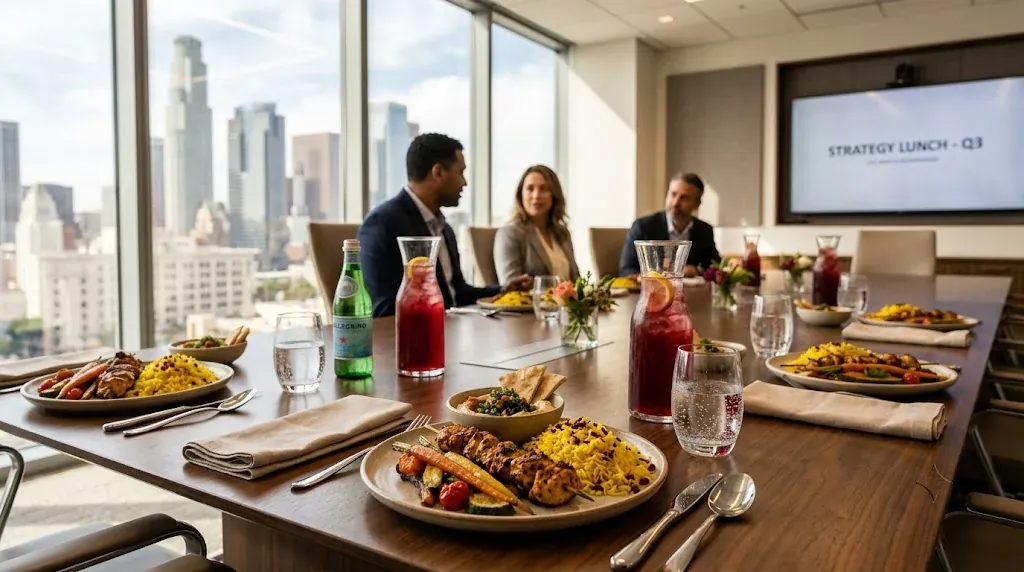
A board lunch is not a corporate lunch
Most catering advice is written for a room of fifty people who are pleased to be fed. A board meeting is eight to twenty people who did not come for the food, are being paid a great deal per hour to be there, and will notice everything that interrupts them. The brief is almost the opposite of a company party: the measure of success is that nobody had to think about lunch.
That changes what you are actually buying. You are not buying variety, or abundance, or a centrepiece. You are buying the absence of interruption — food that appears and is cleared without anyone breaking a sentence, staff who do not introduce themselves to the table, and no question put to a director that could have been answered a week earlier. Almost every decision below follows from that one.
It also changes who decides. Board catering is booked by an executive assistant or chief of staff and judged by people who were not consulted. The safest position for the person booking it is a format that cannot go wrong in front of an audience, which usually means fewer moving parts than the budget would allow.
Choose the format from the agenda, not the menu
The single most useful thing you can do is read the agenda before you read a menu. Whether the session has a genuine seated break — and how long it is — determines the format, and the format determines almost everything else. Caterers who ask what you want to eat before they ask how the day runs are guessing.
| If the agenda says | Use | Why | Watch out for |
|---|---|---|---|
| A real 45–60 minute break, seated | Plated service | The room feels like a private dining room; courses land on cue and clear together | Needs staff in the room and more runway; overruns are harder to absorb |
| They will eat while they work | Composed boards, staged outside | Nothing arrives through the door mid-discussion; guests serve themselves in the gaps | Boards, not catering trays — the difference is visible at this level |
| A hard stop, or people joining remotely | Individually boxed | No shared surfaces, no serving decisions, and anyone can take it with them | Label every box; an unlabelled box is a question asked of a director |
| Back-to-back sessions, no break at all | Continuous refresh | Coffee, fruit and pastry replenished between items rather than set once | Refresh timing has to be written into the run of show, not improvised |
Formats, not quotes. The right one is set by the agenda; the price is set by the menu, the headcount and the date.
The question nobody answers: the meeting ran ninety minutes long
Board meetings overrun. It is the most predictable thing about them, and it is the one thing the catering guides do not cover. The honest answer depends on which of two systems the food is being held under, and the difference matters more than most people expect.
Under temperature control, time is not the constraint. California's Retail Food Code (CRFC §113996) requires potentially hazardous food to sit at or above 135°F hot, or at or below 41°F cold. Food genuinely held at those temperatures — in chafers, in a hot box, in a cold well — is not on a clock. A meeting that runs long is a service problem, not a safety one. The statute also carves out transport of under thirty minutes; beyond that, transport is holding and the temperatures apply.
Under time control, the clock is shorter than you think and it did not start when you think. Where time alone is used instead of temperature (CRFC §114000), ready-to-eat food gets four hours — but the four hours run from the moment the food LEAVES temperature control, not from the moment service begins. A lunch that came out of refrigeration at 9am to be plated has already spent most of its window before a single director sits down at 1pm. The rule also requires the containers to be marked with the discard time and written procedures kept at the facility; food in unmarked containers must be discarded regardless of how it looks, and re-chilling does not reset the clock.
A third rule is routinely confused with the second. Preparation out of temperature is capped at two cumulative hours (CRFC §113998) — a separate limit for a separate situation, not a shorter version of the four-hour one. Both are cumulative, and neither substitutes for the other.
What this means for you is a single question worth asking before you book: is the food being held on temperature or on time, and if on time, when does the clock start? A caterer who can answer that immediately has thought about your overrun. One who cannot has not. Practically, the way to be safe against a long session is to plan to hold rather than to serve on the hour — food staged outside the room under temperature control can wait out an agenda; food already sitting on the table cannot.
These are California state figures. Los Angeles County — and, separately, Long Beach, Pasadena and Vernon, which run their own health departments — may enforce stricter rules, so confirm the local position for your specific address rather than treating a state floor as the last word.
What to send the caterer, in the first email
Almost every problem on the day traces back to something that was knowable a week earlier. Sending this list up front replaces three rounds of email and, more importantly, means nobody has to ask a director anything.
- The run of show, not just the lunch slot — where the breaks fall, when the speeches happen, and which items are likely to overrun. This is what lets service be placed in the gaps rather than on the hour.
- The attendee list with dietary requirements against names. Planning against the list is the only way to avoid a spare vegetarian tray standing in for real dietary care, and it is the difference between a director being catered for and being accommodated.
- Building access: the loading dock, the freight elevator, security clearance, and whether staff need to be listed in advance. In a downtown tower this is the most common cause of a late setup, and it has nothing to do with the kitchen.
- The room's house rules — what may be brought in, what may be cooked on site, whether open flame or chafer fuel is permitted, and what has to leave with the caterer. Confirm these before quoting rather than discovering them at load-in.
- Whether the room is shared or observed: does the space need to look untouched fifteen minutes after service, and is anything being recorded or streamed while food is on the table?
- Invoicing requirements — PO number, cost centre, net terms, and whether a certificate of insurance needs to be on file with the building before the date.
What it costs per head in Los Angeles
Corporate catering is quoted per guest, and the spread across meeting types is wider than most budgets assume — a board lunch is routinely double an office lunch for the same headcount, because what is being bought is service rather than food. These are our own published floors, so treat them as the bottom of each bracket rather than a quote.
| Meeting type | From | What drives the number |
|---|---|---|
| Office lunch | $15 | Delivered, set and labelled; no staff on site |
| Working lunch | $17 | Eaten during the session; individually portioned |
| Corporate catering | $18 | General company catering; buffet or boards |
| Conference | $22 | Volume and repeated service across a day |
| Board meeting | $34 | Silent service, staged setup, staff in attendance |
| Client dinner | $46 | Plated courses, full front-of-house |
Starting prices, not quotes — every menu halal · zabiha-sourced by default. Board and client-dinner service carries staffing that drop-off formats do not, which is most of the gap.
Dietary requirements at director level
A board table is small enough that one badly handled requirement is conspicuous. The failure mode is not usually the absence of an option — it is a director having to ask what is in something, in front of the room, and getting an uncertain answer.
Two habits prevent nearly all of it. Label every dish rather than relying on a server to remember, so nobody has to ask. And plan against the attendee list in advance rather than covering requirements with a spare tray, so the person with the requirement is eating the same standard of food as everyone else rather than the alternative.
On sourcing, be precise rather than reassuring, and expect the same from your caterer. Our menus are halal · zabiha-sourced and we say exactly that: our own kitchen and our partner kitchens prepare to those conventions and we label per dish, and we will talk a specific requirement through directly rather than claim a certification we do not hold. Vegetarian, vegan and gluten-free run as standing lines rather than as substitutions. A caterer who answers a sourcing question with a vague yes is a risk at a table where somebody will ask a precise one.
The week-of checklist
Everything above is decided weeks out. This is the short list worth re-running in the last few days, when the agenda has moved and the headcount has not been reconfirmed.
- Reconfirm the headcount and re-read the agenda — board attendance and running order both move late, and the format you chose was chosen from the agenda.
- Confirm building access and that the catering staff are on the security list by name, if the building requires it.
- Ask where service will be staged. If the answer is "in the room", ask again — staging outside the room is what makes an overrun survivable.
- Confirm whether the food is held on temperature or on time, and if on time, what the marked discard time will be.
- Check the labelling plan against the attendee list, not against the menu.
- Agree a clearing signal with the captain — who nods, and when — so nobody has to interrupt to ask whether the room is finished.
- Confirm the invoice details, PO number and any certificate of insurance the building needs on file before the date.