Is it cheaper to cater or cook for a party?
For fewer than about twenty guests, cooking it yourself is almost always cheaper, and the gap is wide. For fifty and up it narrows fast, and somewhere in between the honest answer stops being about money at all.
The reason is that the costs do not scale the same way. Ingredients scale linearly — twice the guests, twice the food. Everything else does not. Cooking for a hundred at home means oven capacity you do not have, holding equipment you would need to rent, serving dishes, ice, transport, and somebody spending the party in the kitchen instead of at it. Those are real costs even when no money changes hands for them, and they arrive all at once rather than gradually.
The comparison people usually make is the wrong one: grocery receipt against catering invoice. The fair comparison is grocery receipt plus rentals plus your own two days plus the risk of getting it wrong in front of everyone you invited, against a number that is fixed in advance. Below twenty, cook. Above fifty, the case for catering is rarely about the food being cheaper and usually about the total being predictable.
If the budget is genuinely tight at fifty or a hundred, the useful question is not whether to cater but which format to cater in — and that is where almost all of the money actually moves.
The most expensive misunderstanding in a catering enquiry
Before any of the cost-cutting below matters, there is one thing worth getting straight, because it is invisible until the proposal lands and it is routinely wrong by about a factor of two.
When a client says “my budget is $50 to $100 a head”, they almost always mean the total cheque they will write — everything in. When a caterer hears it, they may well price it as the FOOD line, with staffing, rentals, delivery, setup, breakdown, service charge and California sales tax itemised separately on top. Both models are genuinely in use across the trade. Neither is dishonest. But a menu designed at $87 a head against a budget meant as $100 all-in comes back as a proposal near $150, and nothing was mispriced — the two sides were measuring different things.
A practitioner rule of thumb is that food is roughly half of a client's total catering spend, with staffing, fees and tax making up the rest. Treat that as a sanity check rather than a planning figure — it rests on a single practitioner source, not a trade study — but it is the right order of magnitude, and it is the fastest way to tell which model a quote is written in.
So the first question to ask any caterer, including us, is: does this number include staffing, delivery, rentals, service charge and tax, or not? If the answer is anything other than a straight one, you do not yet have a budget — you have a food line. We price ours as the food per guest and itemise the rest, and we say so on every proposal rather than leaving you to discover it.
- Ask what the per-head number includes before comparing any two quotes
- In California, sales tax and a mandatory service charge are additional either way, and must be stated separately
- If the answer has not come back, work backwards from the total you will actually pay
- A quote that is 40% below every other quote is usually a food line, not a bargain
The cheapest way to cater for 50 people
Drop-off, one protein, self-serve, on a weekday. That combination is the floor, and each part of it is doing real work.
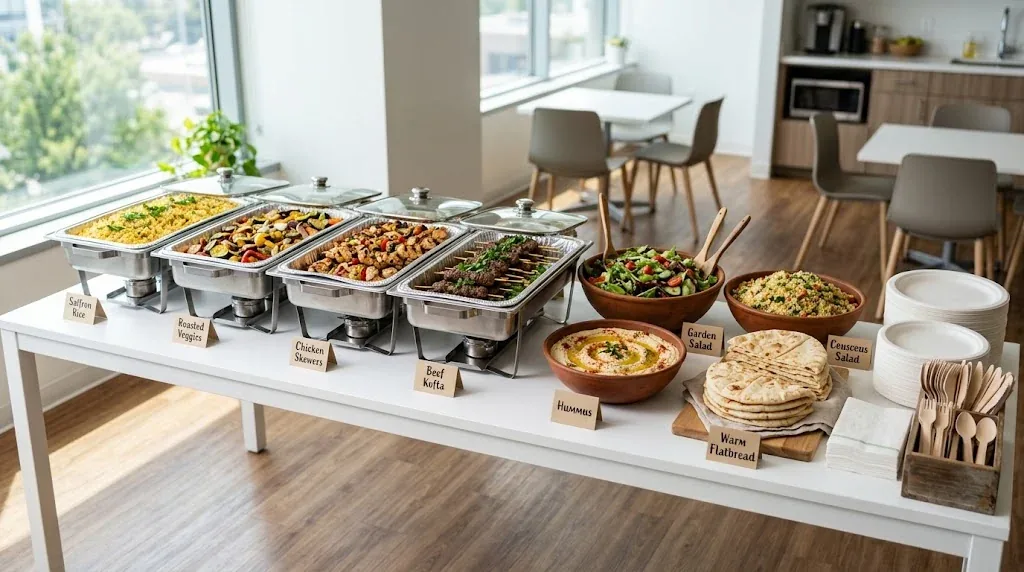
Drop-off is the single biggest lever because it removes staffing entirely — trays and warmers delivered, set and labeled, and nobody stays. Our drop-off band is $14–$40 per guest against $28–$55 for a staffed buffet and $45–$85 for plated service, and the food on the tray can be identical across all three. You are paying for people and rentals, not for a different kitchen.
One protein instead of two is the second lever and the one people resist hardest. Two proteins do not halve the quantity of each — guests take some of both — so a second protein adds materially more than it removes. A single well-chosen protein with two generous sides reads as abundant; two thin proteins read as rationed.
Across our package range, fifty guests works out to roughly $1,100–$5,150 for the food, and where you land inside that is decided by format far more than by menu. Fifty is also the size where the arithmetic starts working in your favour: below about thirty the crew and delivery minimums dominate the per-head figure no matter what you order.
- Drop-off over staffed service — the largest single saving available
- One protein, two sides, done well, over two proteins spread thin
- Weekday over Saturday; daytime over evening
- Self-serve over anything portioned or plated by hand
- Disposable serviceware over rented china, which is a rental line and a collection fee
What is the cheapest food to feed 100 people?
Dishes where a starch or legume carries the plate and the protein flavours it, rather than dishes where the protein IS the plate. That is the whole principle, and every cheap-per-head cuisine in the world arrives at it independently.
In practice: rice and grain dishes, stews and braises served over something, pasta bakes, bean and lentil dishes, and anything built as a bar where guests assemble their own — tacos, rice bowls, mezze. A braise also uses the cheaper cuts, which are the ones that improve with long cooking, so the saving costs you nothing on the plate.
What is expensive is portion-controlled protein: a piece of fish or a steak per person sets a hard floor per head that no amount of clever ordering moves. Seafood in general, and anything requiring last-minute cooking to order, carry a premium that is about labour and timing rather than ingredient cost.
A hundred guests across our package range is roughly $2,200–$10,300 for the food. A hundred is also where per-head pricing gets most efficient, because the crew, the equipment and the delivery cost much the same as they do for sixty — the fixed costs simply spread further.
- Rice, grain and pasta dishes — high yield, holds well, scales cleanly
- Braises and stews — cheaper cuts that are better for the slow cooking
- Bean, lentil and chickpea dishes — the cheapest protein on any menu
- Assemble-your-own bars — guests self-portion, and perceived choice is high
- Avoid: per-person fish or steak, anything cooked to order, anything plated by hand
Feeding twenty, where the arithmetic inverts
Twenty is the awkward size. It is too many to cook for comfortably and too few to spread a caterer's fixed costs, so the per-head number looks worst exactly where budgets are usually smallest.
The fix is to stop optimising per head and optimise the minimum instead. Boxed meals work well at twenty because there is no equipment, no setup and no waste — you order exactly twenty. A grazing table works because it is priced as a table rather than as a headcount. What does not work at twenty is a staffed format: you are paying a crew minimum that a hundred guests would have absorbed invisibly.
For a crowd of twenty the best food is whatever needs no service: something substantial that holds at room temperature, one hot tray, and a spread people pick at over an hour or two rather than a seated meal with a beginning and an end.
Seven ways to cut the number without cutting the food
In rough order of how much they save, and none of them make the table look smaller.
- Change the format, not the menu — the same dishes dropped off rather than served staffed
- Move the date off Saturday, and the time out of the evening
- Drop to one protein and add a second substantial vegetable dish in its place
- Take the disposables — good compostable serviceware costs a fraction of rented china plus its collection
- Cut the passed appetisers before you cut the main — they are priced per piece per hour and they are where a budget quietly leaks
- Shorten the service window; crew is quoted against hours on site, not against headcount
- Give a real headcount rather than a generous one — over-ordering is the most common overspend and the least visible
What we charge, and where we are not the cheapest
Our packages run $22 to $103 per guest for the food. That is not the bottom of the Los Angeles market and we are not going to pretend otherwise: published trade figures put bare drop-off in this market from around $10 a head, and there are operators who will quote below us.
What we will do is tell you exactly what the number covers before you ask. Every proposal states the food per guest, the staffing, the rentals, the delivery and the service charge as separate lines, with California sales tax shown rather than folded in — so the figure you compare against another quote is the same kind of figure. Most of the budget overruns we see are not overcharging; they are two numbers that were never the same number.
The food itself is halal and zabiha-sourced throughout, with no pork and no alcohol anywhere in the kitchen. For a mixed guest list that removes a whole category of cost and complication — no second menu, no separate trays, no guest reading labels — which on a tight budget is worth more than a dollar or two a head.