How much brisket per person?
Half a pound — 8 ounces — of COOKED brisket per adult when brisket is the main meat, which means buying about a pound of raw whole brisket for each guest. The two numbers are different by roughly a factor of two, and that is the entire subject of this section.
A whole packer brisket loses about half its weight between the butcher's counter and the slicing board. It loses some to the fat cap you trim off and a great deal more to a cook measured in hours rather than minutes. A twelve-pound brisket that looks like far too much when you buy it slices out at about six pounds of meat.
That fifty percent is specific to brisket and it is worth saying why. Taco fillings lose about a quarter of their weight; a trimmed beef tenderloin keeps seventy to seventy-five percent of its. Brisket is punished twice, by the trim and by the length of the cook, so it lands near half. Applying the ordinary shrinkage figure to a brisket order understates the shortfall by about double, and the mistake only shows up when the line is still moving and the meat is gone.
Treat this as a planning bracket rather than a standard. The sources that publish brisket yields are a working Texas barbecue caterer, two enthusiast calculators and a practitioner forum — no regulatory or trade study exists for it. They agree closely on the yield and disagree on the serving size, which is the more useful disagreement: 8 ounces when brisket is the only main, around 6 as a general default, and as little as 4 when it shares the line with chicken and sausage. What moves that number is what else is on the table, not how hungry the room is.
- 1 lb raw whole brisket per adult when brisket is the main meat
- About 50% cooked yield — plan at half, treat anything above it as margin
- 8 oz cooked per adult as the sole main; 4–6 oz when other meats share the line
- Order in raw pounds, serve in cooked ounces, and never convert with the taco figure
How many people will a 20 lb brisket feed?
About twenty adults, if brisket is the only meat you are serving. Twenty raw pounds cooks down to roughly ten, which is 160 ounces, and at the half-pound serving that is twenty people.
Put chicken and sausage on the line beside it and the same twenty pounds stretches to somewhere between twenty-six and forty, because each guest now takes four to six ounces of brisket rather than eight. That is the cheapest way to make a brisket order go further, and it also gives the table more to look at.
One caution that applies to every number on this page: the error here is one-directional. Over-ordering brisket costs money and produces leftovers that are genuinely good the next day. Under-ordering ends the service. Plan the yield at fifty percent even though some of your briskets will do better, and buy the round number above what the arithmetic gives you.
How to cater a barbecue for 50 people
The arithmetic, laid out, so you can see which number you are actually buying. Cooked weights are what reaches the plate; raw is what you order.
Brisket as the sole main needs about 1 lb of raw whole brisket per adult, so 50 guests takes roughly 50 lb raw for 25 lb cooked.
| Guests | Brisket only — raw | Brisket only — cooked | Shared with 2 other meats — raw |
|---|---|---|---|
| 20 | 20 lb | 10 lb | 10–15 lb |
| 50 | 50 lb | 25 lb | 25–38 lb |
| 100 | 100 lb | 50 lb | 50–75 lb |
Planning brackets at a 50% cooked yield, from a working Texas BBQ caterer and three enthusiast sources — not an industry standard. Your proposal carries the exact itemized figures.
What to serve at a barbecue for 50 people
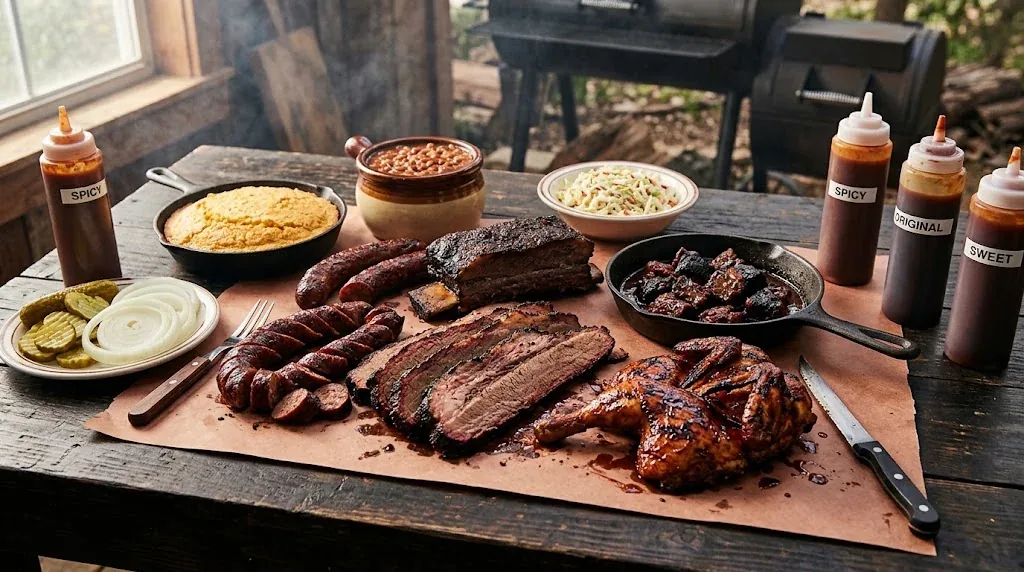
Two or three sides at roughly 4 to 6 ounces a head each, bread, and a sharp pickle to cut the fat. The sides are not filler — on a barbecue they are the reason the meat order can be smaller, and they are the first thing that runs out when a budget gets trimmed in the wrong place.
The classic error is a meat-heavy table with one lonely side. Guests serving themselves take more of the side and ration themselves on the brisket, so a thin side line pushes consumption straight onto the most expensive thing you bought. Cornbread, baked beans and coleslaw earn their place three times over at fifty guests.
- Smoky baked beans and creamy coleslaw — 4–6 oz per person each
- Cornbread, and more of it than feels necessary
- Pickles and sliced raw onion — cheap, and the thing people miss when it is absent
- Two sauces at different heat levels, labeled
- Iced tea, lemonade or horchata — our drinks list is alcohol-free throughout
What is the cheapest meat to feed a crowd?
Chicken, by a wide margin, and it is not close. Quartered barbecue chicken costs a fraction of brisket per pound, loses far less in cooking, and needs a fraction of the time on the pit. If the budget is the constraint, chicken is the answer and no amount of clever ordering changes that.
Brisket is the opposite case: it is expensive per raw pound and then you throw half of it away. What you are buying is not calories, it is the thing people photograph and talk about afterwards. The sensible resolution on a real budget is not to choose between them but to put brisket on the table as the centrepiece and let chicken and sausage carry the volume — which is exactly what the three-meat column in the table above is doing.
For a fuller treatment of where catering money actually goes, and the single misunderstanding that makes proposals land at twice the budget you set, see our guide to the cheapest way to cater for 50 or 100 people.
Can I hire someone to grill at my party?
Yes, and it is the format most people picture when they imagine barbecue catering: a pit or plancha on site, someone tending it, and meat carved to order rather than arriving in a tray. It costs more than a drop-off for a reason worth understanding before you compare quotes.
A station attendant is additional labour, not a substitute for floor staff. Booking a chef at the grill adds a person to the crew rather than replacing part of it, and that is the most common surprise on a barbecue quote. The attended station is also the only format here that needs real planning around the site: power or fuel, floor space, clearance, and somewhere for the smoke to go that is not the neighbours.
A drop-off works for offices, crews and anything where people eat where they are: trays, warmers, bread wrapped to stay soft, and we are gone. Tell us the site before you tell us the menu — a park with no power and a studio lot with a twenty-minute dock window are different jobs, and the site decides the format far more often than the food does.
Barbecue without pork, which is most of the canon rebuilt
American barbecue leans hard on pork — pulled shoulder, ribs, sausage, and bacon in half the sides — so a mixed guest list usually means most of the menu quietly disappears. Ours is built the other way round from the start.
Our smoked beef brisket and beef short ribs are the centre of it, with brisket burnt ends, pulled BEEF rather than pulled pork, halal beef sausage, barbecue chicken, charcoal beef and lamb chops. The baked beans are smoky without the bacon. Everything is halal and zabiha-sourced, there is no pork and no alcohol anywhere in the kitchen, and the practical effect is that the whole table is for the whole room.
That is not a smaller barbecue menu with the pork removed. Brisket and short rib are the two cuts Texas barbecue is actually judged on, and both are beef — which means the part of the canon that matters most was never the part we had to work around.
- Smoked beef brisket and smoked beef short ribs — the centre of the menu
- Brisket burnt ends, pulled beef, halal beef sausage, charcoal beef, lamb chops
- BBQ chicken and grilled seafood for the volume and the variety
- Cornbread, smoky baked beans, coleslaw and fries — no bacon anywhere
- One spread the whole room eats from, with no second tray in the corner